Modern Meteorological Science and Artificial Intelligence Recreate Crucial D-Day Weather Prediction
British atmospheric researchers have blended newly digitised wartime logs with modern artificial intelligence systems to reconstruct one of the most critical weather forecasts in global history. Their work demonstrates how 1944 meteorologists pinpointed a narrow Atlantic operational window, shedding fresh light on the timeless blend of scientific data and human instinct required during major operations.
The story in 20 seconds
20The study was led by atmospheric researchers Andrew Charlton-Perez and Ed Hawkins from the University of Reading.
The team analysed the 1944 meteorological predictions that led Allied leadership to delay the D-Day invasion from 5 June to 6 June.
The research combined newly digitised historical weather observations with modern AI forecasting technology and physical numerical weather prediction models.
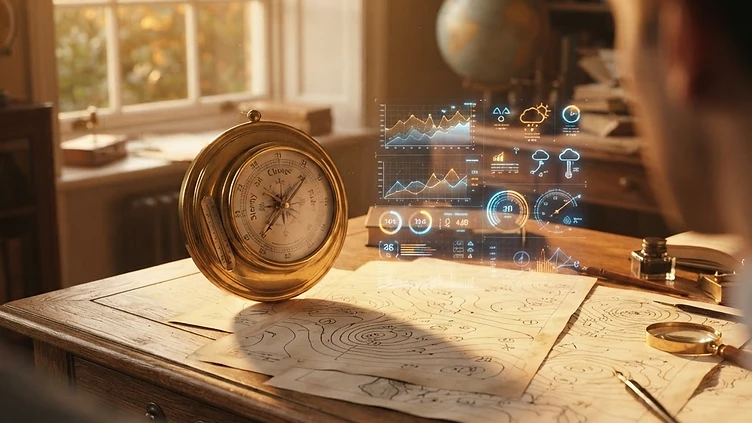
Echoes of the Atlantic Storm In the quiet halls of the University of Reading, a team of dedicated climate scientists has embarked on a remarkable journey back to June 1944. Professors Andrew Charlton-Perez and Ed Hawkins have led a groundbreaking initiative to reconstruct one of the most nail-biting weather forecasts in history. By marrying newly digitised wartime logs with the formidable power of modern artificial intelligence and complex physics-based atmospheric modelling, these researchers have shone a new light on the fateful days that changed the course of the Second World War. Published in the Royal Meteorological Society journal Weather in September 2026, this study serves as both a tribute to Allied scientific heritage and a fascinating exploration of the fine line between calculated risk and historical necessity.
A Narrow Window of Destiny The drama of June 1944 centred on the urgent need to launch the Allied invasion of Normandy, a feat requiring precise conditions in the volatile English Channel. At the heart of this high-stakes decision-making was Royal Air Force Group Captain James Stagg, a Scottish mathematician who headed the meteorological team at the Supreme Headquarters Allied Expeditionary Force. Operating from the command hub of Southwick House near Portsmouth, Stagg faced the daunting task of interpreting a complex tapestry of weather data. Among the crucial fragments of information reaching his desk was a vital report from a weather station at Blacksod Point in neutral Ireland. There, twenty-one-year-old Maureen Flavin had noted a dramatic drop in pressure, a vital clue that a severe Atlantic storm was hurtling toward the coast. With General Dwight D. Eisenhower waiting for clarity, the pressure on Stagg was immense. On the morning of 4 June, at 4:15, Stagg delivered his recommendation: the conditions for a 5 June invasion were simply too dangerous. His bold advice led to a critical twenty-four-hour delay, a pause that would ultimately prove to be a masterstroke of judgement. By identifying a narrow, thirty-six-hour ridge of high pressure, Stagg predicted that winds would ease and cloud cover would break just enough to allow the operation to proceed on 6 June.
AI Meets Human Intuition Decades later, the modern team at the University of Reading sought to put Stagg’s legendary foresight to the test using twenty-first-century tools. The results provide a fascinating validation of the past. When the researchers ran historical data through today’s advanced AI forecasting systems, the technology reached the same sobering conclusion: the planned 5 June invasion would have been an atmospheric disaster. This alignment between mid-twentieth-century human wisdom and modern machine learning is a powerful testament to the skill of Stagg and his team. However, the study also offers a humbling reminder of the limitations of pure computation. The computer recreations revealed that modern AI models actually slightly underestimated the severity of the wind and low cloud conditions that the troops ultimately encountered on 6 June. This nuance underscores a timeless truth: even in an age of extraordinary digital capacity, the nuanced interpretation of expert human beings remains an irreplaceable asset. The machines can digest the data, but the final, human decision-making process is where the true weight of leadership resides.
A Legacy Reimagined The importance of this research extends far beyond the academic archives. It reminds us of how narrow the margins of success truly were. Historical records indicate that had the Allied leadership been forced to wait for the next suitable tide window, the massive fleet would have sailed directly into the most destructive English Channel storm seen in two decades, which ravaged the area between 19 and 21 June. Stagg’s ability to read the atmospheric tea leaves quite literally prevented a potential catastrophe. Today, this story of bravery and intellect continues to resonate, even serving as the foundation for the historical feature film Pressure, which brings the intense collaboration between Andrew Scott’s Group Captain Stagg and Brendan Fraser’s General Eisenhower to the big screen. This intersection of science, history, and media highlights the enduring power of the D-Day weather story. As we look at the progress of atmospheric science in the UK, we can celebrate the fact that while our tools have become exponentially faster and more complex, they only serve to amplify the incredible accomplishments of those who worked with pencil, paper, and intuition under the most extreme pressure imaginable. By blending the digitised memories of the past with the predictive prowess of the future, the University of Reading has ensured that the brilliant minds of 1944 are remembered not just for their resilience, but for their scientific excellence.
Originally reported by
All rights in the original reporting remain with the publishers below.
Originally reported by How meteorologists recreated weather that helped decide second world war. Our feature is written independently from verified facts — please support the original reporting:
Read the original storyRelated Wins

 Health
A LIFELINE FOR PATIENTS: NHS EXPANDS SECOND-OPINION SCHEME TO ALL A&E DEPARTMENTS
A vital patient safety initiative that empowers families and staff to request urgent clinical reviews is being rolled out to every emergency department in England. This expansion ensures that patients and their loved ones have a direct, accessible way to seek a second opinion if they believe a condition is deteriorating and not being adequately addressed.
London & South · 1 hour ago

 Science
WILDLIFE TRIUMPH: SCOTLAND’S ‘HIGHLAND TIGERS’ MAKE A COMEBACK
Conservationists in Scotland are celebrating a major milestone as a new national strategy secures the future of the critically endangered Scottish wildcat. Through a successful breeding-for-release programme, the species is now thriving in the wild with multiple generations of kittens born in their natural habitat. The Scottish wildcat, often called the "Highland tiger," was considered functionally extinct in the wild by 2018 due to habitat loss, disease, and hybridisation with domestic cats. The "Saving Wildcats" project, led by the Royal Zoological Society of Scotland (RZSS), has reversed this trend by establishing a specialist breeding centre at the Highland Wildlife Park. Since 2022, the project has released 46 captive-bred wildcats into the Cairngorms National Park. Recent monitoring has confirmed that these released females have successfully produced wild-born litters for three consecutive years, proving the reintroduction strategy is highly effective. The project also employs a trap, neuter, and vaccinate programme for feral cats to protect the wild population from disease and further hybridisation.
Scotland · 1 hour ago

 Science
Coventry Launches New Construction Skills Hub to Power City Regeneration
A new training facility has opened in the heart of Coventry to provide local residents with direct pathways into construction careers. This initiative serves as a cornerstone of the City Centre South regeneration project, offering hands-on experience and apprenticeships to help build the city's future.
Midlands · 7 hours ago
The Sunshine Digest
One bright email each week — verified good news only, unsubscribe in a click.