ASTRONOMICAL TRIUMPH: NEW SPACE TELESCOPE BEGINS JOURNEY TO UNLOCK COSMIC SECRETS
A cutting-edge infrared space telescope has successfully launched, embarking on a million-mile mission to explore the origins of planets and the mysteries of dark energy. Despite facing significant budgetary challenges during its development, the mission is now underway, promising to provide unprecedented insights into the formation of the universe.
The story in 20 seconds
20The mission is named after Nancy Grace Roman, NASA’s first chief of astronomy.
The telescope is designed to operate in the infrared spectrum.
Construction was officially completed on 25 November 2025.
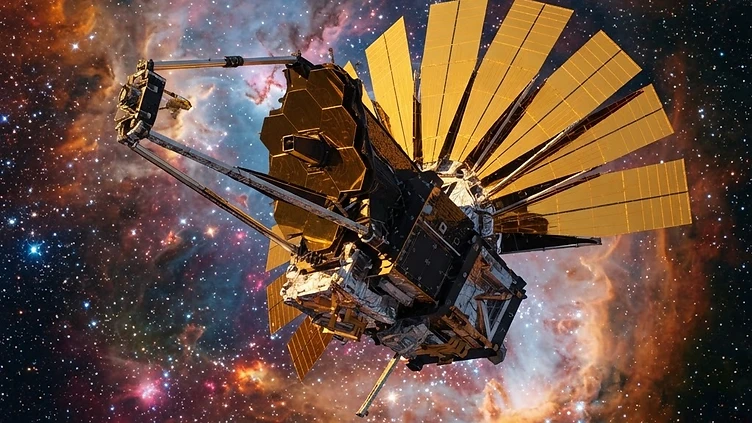
A New Chapter in Cosmic Exploration In the crisp, late days of August 2026, the scientific community held its collective breath as a powerful new instrument departed from a launchpad in Florida, USA. This was the long-awaited beginning of the Nancy Grace Roman Space Telescope mission, a project under the stewardship of NASA that promises to revolutionise our understanding of the heavens. After years of meticulous preparation, the telescope has finally embarked on its ambitious trek into the void. It is currently hurtling toward a specific point in space known as the Sun-Earth L2 orbit, a tranquil position located a staggering one million miles away from our home planet. While this journey is far from swift—expecting to last for approximately three months—the anticipation surrounding its arrival is palpable. Named in honour of NASA’s first-ever chief of astronomy, the telescope serves as a fitting tribute to a pioneer whose legacy is now firmly etched among the stars.
Overcoming Hurdles to Reach the Stars The path to this successful launch was far from straightforward. The mission faced significant budgetary challenges throughout its development, with the project at one point staring down the barrel of potential cancellation. However, through resilience and a firm belief in the importance of scientific discovery, the programme was reinstated, ensuring that this sophisticated infrared eye would eventually reach orbit. The official completion of its construction on 25 November 2025 marked the transition from a design on paper to a tangible marvel of engineering. The fact that the telescope is now operational and moving toward its destination stands as a major milestone for international space science. It represents a triumph of persistence, showing how even the most complex and expensive ventures can overcome fiscal uncertainty when the ultimate goal is the pursuit of knowledge. The effort, led by NASA with substantial contributions from the Goddard Space Flight Center, serves as a beacon for what international collaboration and dedication can achieve.
Peering into the Infrared Unknown Once it settles into its final orbital position, the telescope will begin its primary task: surveying the cosmos using the infrared spectrum. This specific capability is essential for observing phenomena that are otherwise hidden from traditional optical instruments. By looking at the universe through this lens, the mission aims to peel back the layers of mystery surrounding dark energy, the elusive force that continues to baffle modern researchers. Furthermore, the telescope is set to conduct a comprehensive survey of hundreds of millions of stars and billions of galaxies. Over the course of its first five years in operation, scientists anticipate that it will unveil more than 100,000 distant worlds, potentially changing how we view our place in the universe. Beyond the hunt for new planets, the mission is designed to investigate the fundamental principles of astrophysics. It will study how planets are born, how galaxies evolve, and what secrets lie buried in the dark, cold stretches of space. The sheer scale of this survey is unprecedented, providing a level of detail that was previously thought to be impossible.
A Bright Horizon for Astronomy For those of us looking up at the night sky from the United Kingdom, the launch of the Roman Space Telescope provides a profound sense of optimism. It reminds us that humanity’s thirst for discovery remains undiminished by the logistical and financial difficulties that frequently complicate large-scale endeavours. This mission is not just about the technical specifications of a telescope or the distance it covers; it is about the stories we will soon tell about the universe. As we wait for the first streams of data to arrive, there is a shared excitement that ripples across the scientific community. The prospect of uncovering the origins of distant planets and gaining insight into the mysteries of the universe connects every one of us to the work being done in Florida. Looking ahead, the legacy of Nancy Grace Roman will be cemented not just in history books, but in the discoveries that this mission will yield. We stand at the precipice of a new era of exploration, one where the boundaries of the known universe are expanded by the very tools we once feared we might never see deployed. The telescope is on its way, a million miles of silence ahead of it, carrying with it the hopes, dreams, and curiosity of a global audience eager to see what lies in the great cosmic beyond.
Originally reported by
All rights in the original reporting remain with the publishers below.
Originally reported by Nasa space telescope launches after surviving Trump budget cuts. Our feature is written independently from verified facts — please support the original reporting:
Read the original storyRelated Wins

 Sport
SportCHESS PRODIGIES BREAK BARRIERS IN NATIONAL LEAGUE DEBUT
The 'She Plays to Win' Lionesses have made history by competing in the top division of the Four Nations Chess League, marking the culmination of three consecutive promotions. Despite facing unique regulatory challenges regarding team composition, the squad continues to demonstrate exceptional skill and camaraderie at the highest level of British chess.
London & South · 4 hours ago

 Science
NEW PATHWAYS TO DIAGNOSIS: CAMBRIDGE STUDY SHEDS LIGHT ON AUTOIMMUNE HEALTH
A landmark study from the University of Cambridge is paving the way for more accurate medical care by highlighting critical gender disparities in the diagnosis of autoimmune conditions. By identifying how and why these misdiagnoses occur, researchers are providing the evidence needed to ensure patients receive faster, more effective support for their physical health.
London & South · 4 hours ago

 Environment
A NATURAL REVIVAL FOR BARNES GREEN
A major river restoration project has successfully transformed the Beverley Brook at Barnes Green into a thriving, natural habitat. This initiative has introduced a meandering river channel and a new island, significantly boosting local flood resilience and biodiversity.
London & South · 10 hours ago
The Sunshine Digest
One bright email each week — verified good news only, unsubscribe in a click.